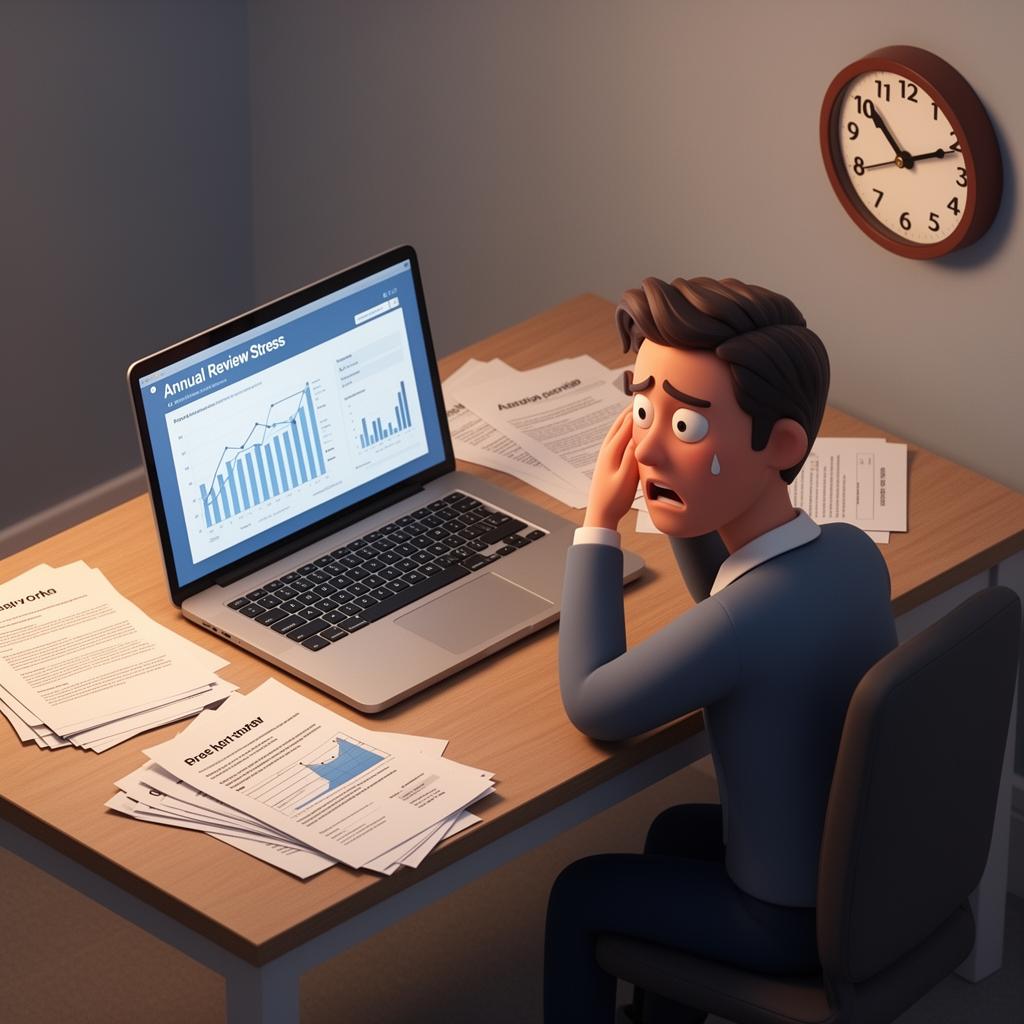
Why Annual Reviews Are So Stressful
Few words cause as much stress in engineering teams as 'annual review'
Few words cause as much stress in engineering teams as "annual review."
For managers, it means weeks of combing through notes, metrics, and vague memories to craft fair evaluations. In some cases, when there are no notes or metrics, its just the memories they have to go on.
For engineers, it's a nerve-wracking process of waiting to hear whether their year-long contributions were recognized, or were overlooked.
Running async standups in Slack throughout the year creates a continuous record that makes review prep dramatically easier.
The truth is, annual reviews feel heavy because they're often treated as the only moment feedback and performance alignment happen. This happens because throughout the year any 1:1 check-ins have focused on the tactical work and not meaningful feedback and planning. But it doesn't have to be that way.
The Problem with Annual Reviews Alone
Annual reviews get stressful when:
- Too much rides on one meeting. Promotion, pay, and recognition are compressed into a single, high-pressure conversation.
- Managers are forced to reconstruct history. Digging through Jira, GitHub, Slack, and fragmented notes to recall 12 months of contributions.
- Engineers feel blindsided. Surprises create anxiety and erode trust.
In short: annual reviews become stressful because they're treated as a catch-up, rather than a capstone.
The Recency Bias Problem
Human memory is predictably flawed when it comes to performance evaluation. We suffer from recency bias — overweighting recent events and underweighting distant ones. This creates several problems during annual reviews:
The Last Quarter Phenomenon
Managers vividly remember the engineer who shipped a critical bug fix in November but forget the complex infrastructure work they completed in February. The engineer who struggled with a project in October gets penalized even if they had nine months of strong performance.
The Crisis Memory Effect
Dramatic events stick in memory while steady, reliable contributions fade. The engineer who stayed late to fix a production outage gets remembered, while the one who prevented three outages through careful code review gets forgotten.
The Visibility Trap
Engineers who work on customer-facing features or speak up in meetings get noticed more than those who tackle backend optimization or mentor junior developers quietly. Impact gets confused with visibility.
The Project End Date Bias
Work that completes near review time feels more significant than work completed months earlier, even if the earlier work was more complex or valuable.
These aren't moral failings — they're how human cognition works. But they make annual reviews fundamentally unfair unless managers have systematic ways to combat memory limitations.
The solution isn't trying to remember better. It's creating systems that remember for you.
How to Build a Performance Narrative Throughout the Year
Instead of scrambling to reconstruct 12 months of performance during review season, the best managers build a continuous performance narrative. Here's how:
Monthly Performance Notes
Set a recurring calendar reminder to spend 30 minutes each month documenting:
- Major contributions from each team member
- Notable growth or skill development
- Feedback received from other teams or stakeholders
- Areas where coaching was provided
- Any performance concerns or improvement plans
Quarterly Career Conversations
Every quarter, have focused 1:1 conversations about:
- Progress toward annual goals
- New skills developed or demonstrated
- Feedback on recent work and areas for growth
- Career aspirations and next steps
- Alignment between current work and career trajectory
Project Retrospective Documentation
After major projects, capture:
- Each person's specific contributions and impact
- Technical and non-technical growth demonstrated
- Collaboration and leadership examples
- Lessons learned and areas for development
Continuous Feedback Collection
Instead of gathering 360 feedback only during review season:
- Ask for peer feedback after cross-team collaborations
- Collect stakeholder input quarterly, not annually
- Document positive feedback as it happens, not when you're trying to remember it
Data-Driven Insights
Track objective metrics throughout the year:
- Code contribution patterns and complexity
- Code review participation and quality
- Standup engagement and communication patterns
- Goal completion and milestone achievement
- Team collaboration and mentoring activities
When review time arrives, you're not starting from zero — you're synthesizing a year of continuous observation into a comprehensive assessment.
What Good vs Bad Review Feedback Looks Like
The quality of feedback in annual reviews varies dramatically. Here are examples that show the difference:
Bad Feedback Examples:
❌ "Alex is a solid contributor who gets things done."
*Why it's bad: Vague, generic, no specific examples or growth guidance.*
❌ "Sarah needs to improve her communication skills."
*Why it's bad: No context about what specifically needs improvement or how to get better.*
❌ "Mike had some challenges with the Q3 project but overall did well."
*Why it's bad: Focuses on problems without context, solutions, or balanced perspective.*
Good Feedback Examples:
✅ "Alex led the migration of our authentication service from OAuth 1.0 to 2.0, which improved security and reduced login failures by 15%. Throughout the project, Alex proactively communicated with dependent teams, created detailed migration guides, and handled edge cases that prevented user disruption. This demonstrates strong technical leadership and systems thinking."
*Why it's good: Specific project, measurable impact, detailed behaviors, clear competency development.*
✅ "Sarah's code review feedback has become increasingly detailed and constructive. In Q2, her reviews averaged 2-3 comments focused on syntax. By Q4, her reviews average 7-8 comments that include security considerations, performance implications, and maintainability suggestions. Several engineers mentioned that Sarah's reviews helped them learn new patterns. This growth in technical mentoring is exactly what we need for senior engineer promotion."
*Why it's good: Shows progression over time, includes peer impact, connects to career development.*
✅ "Mike's work on the payment service faced significant challenges due to unclear requirements and changing API dependencies. Despite these obstacles, Mike adapted the architecture twice, communicated proactively with stakeholders about timeline impacts, and delivered a solution that met all functional requirements within the extended deadline. The resilience and communication Mike showed during this project demonstrates readiness for more complex, ambiguous work."
*Why it's good: Acknowledges context and challenges, focuses on how problems were handled, identifies growth demonstrated.*
The Pattern:
Good feedback is:
- Specific: Names actual work, behaviors, and outcomes
- Balanced: Acknowledges context and challenges
- Growth-oriented: Connects current performance to future development
- Evidence-based: Uses concrete examples, not impressions
- Forward-looking: Provides clear direction for improvement
The Role of Continuous Feedback
Annual reviews shouldn't contain surprises. If an engineer learns about a performance issue for the first time during their annual review, the manager has failed them throughout the year.
Why Continuous Feedback Matters
Course Correction: Issues addressed in real-time can be resolved. Issues saved for annual discussion become entrenched patterns.
Trust Building: Regular feedback shows you're paying attention and invested in their growth, not just checking boxes once a year.
Skill Development: Engineers can't improve skills they don't know need work. Waiting until review season wastes 12 months of potential growth.
Reduced Anxiety: When performance conversations happen regularly, the annual review becomes a summary, not a revelation.
How to Make Feedback Continuous
In-the-Moment Recognition: When someone does excellent work, tell them immediately — via Slack, in person, or in the next standup. Don't wait for the next 1:1.
Weekly Coaching Moments: Use regular 1:1s for skill development conversations, not just status updates. "I noticed you handled the client feedback on the API design really well — let's talk about what made that interaction successful."
Project Debriefs: After each significant project, spend 10 minutes discussing what went well, what was challenging, and what to do differently next time.
Quarterly Check-ins: Every quarter, have a more formal conversation about goal progress, career development, and performance themes. Make it conversational, not evaluative.
Monthly Team Feedback: Create regular opportunities for peer feedback through retrospectives, informal check-ins, or structured 360 processes.
The goal is to make performance development a continuous conversation rather than an annual event.
Using Data to Write Fair Reviews
Memory is unreliable. Impressions are biased. Data provides the objectivity that makes reviews more accurate and fair.
What Data to Collect
Contribution Metrics
- Lines of code (with context about complexity)
- Pull requests authored and reviewed
- Bug fixes and feature deliveries
- Documentation written and updated
Collaboration Signals
- Code review quality and participation
- Cross-team project involvement
- Mentoring and pair programming sessions
- Meeting participation and leadership
Communication Patterns
- Standup engagement and detail level
- Response time to questions and requests
- Proactive communication about blockers or risks
- Quality of written documentation and proposals
Growth Indicators
- Skills demonstrated through work assignments
- Increasing complexity of tasks tackled
- Leadership opportunities taken or created
- Knowledge sharing through docs, presentations, or training
How to Use Data Effectively
Context is Critical: "Sarah wrote 50% fewer lines of code this quarter" might indicate lower productivity — or it might mean she spent time on architecture design, mentoring, or complex refactoring. Data without context misleads.
Look for Patterns, Not Points: One bad week doesn't indicate poor performance. Three months of declining code review participation suggests a pattern worth discussing.
Combine Quantitative and Qualitative: Use data to identify patterns, then investigate with conversation. "I noticed your standup responses have gotten shorter lately — how are you feeling about your current workload?"
Compare Against Baselines, Not Peers: Engineers have different working styles, roles, and skill levels. Compare each person against their own historical performance, not against teammates.
Weight Impact, Not Volume: An engineer who writes less code but prevents more bugs through careful review may be contributing more value than someone with higher output metrics.
How Vereda AI Helps with Review Prep
Manual review preparation is time-consuming and inconsistent. Vereda AI systematizes the process:
Automated Performance Summary Generation
Vereda AI analyzes 12 months of data and generates summaries like:
"Alex contributed to 23 pull requests, authored 15, and provided 127 code review comments. Contribution complexity increased 40% from Q1 to Q4. Standup engagement remained consistently high with detailed technical updates. Collaborated on 6 cross-team projects, including technical lead role on authentication migration."
Pattern Recognition Across Time
AI identifies trends humans miss:
"Sarah's code review comments became increasingly detailed and constructive throughout the year, suggesting growth in technical mentoring skills. Response time to code reviews improved 30% after Q2 conversation about prioritization."
Strength and Growth Area Identification
Based on behavioral patterns:
"Mike shows strong technical problem-solving (consistently resolves complex bugs) but could develop communication skills (standup responses are brief, limited participation in technical discussions)."
Evidence-Based Narrative Creation
AI connects specific examples to broader performance themes:
"Leadership development is evident through: taking ownership of payment service redesign (June), mentoring two junior engineers on testing practices (Q3), and proactively proposing process improvements that reduced deployment time 25% (October)."
Goal Progress Tracking
Automated monitoring of career development goals:
"Goal: Improve system design skills. Evidence: Led 4 architecture discussions, created design docs for 3 services, received positive stakeholder feedback on API design. Recommendation: Ready for more complex system ownership."
Bias Detection and Correction
AI helps identify potential bias in evaluations:
"Warning: This review focuses heavily on recent performance. Consider including Q1-Q2 contributions to payment optimization and infrastructure improvements for balanced assessment."
Learn more about Vereda AI's automated review preparation capabilities.
Takeaway for Managers
If annual reviews feel like a grind for you and your engineers, the fix isn't to overhaul the review itself. The fix is in the 52 weeks leading up to it.
The transformation happens when you:
- Make 1:1s consistent — Regular coaching conversations mean reviews become summaries, not discoveries
- Bring data into the room — Objective metrics complement subjective observations for fairer, more accurate assessments
- Use AI to help you spot patterns, not just problems — Technology can identify growth trends and skill development that human memory misses
- Create continuous feedback loops — Address issues in real-time rather than saving them for annual events
- Build systematic documentation — Monthly notes and quarterly career conversations create rich performance narratives
Do that, and when review season comes, you'll be writing the final chapter of a story you've already been telling all year — not starting from scratch.
The result: Reviews become collaborative conversations about growth and future goals rather than stressful evaluations of past performance. Engineers feel supported throughout the year, and managers can write detailed, fair assessments with confidence.
For more insights on managing engineering teams effectively, read our guides on effective 1:1 meetings and preventing team burnout.