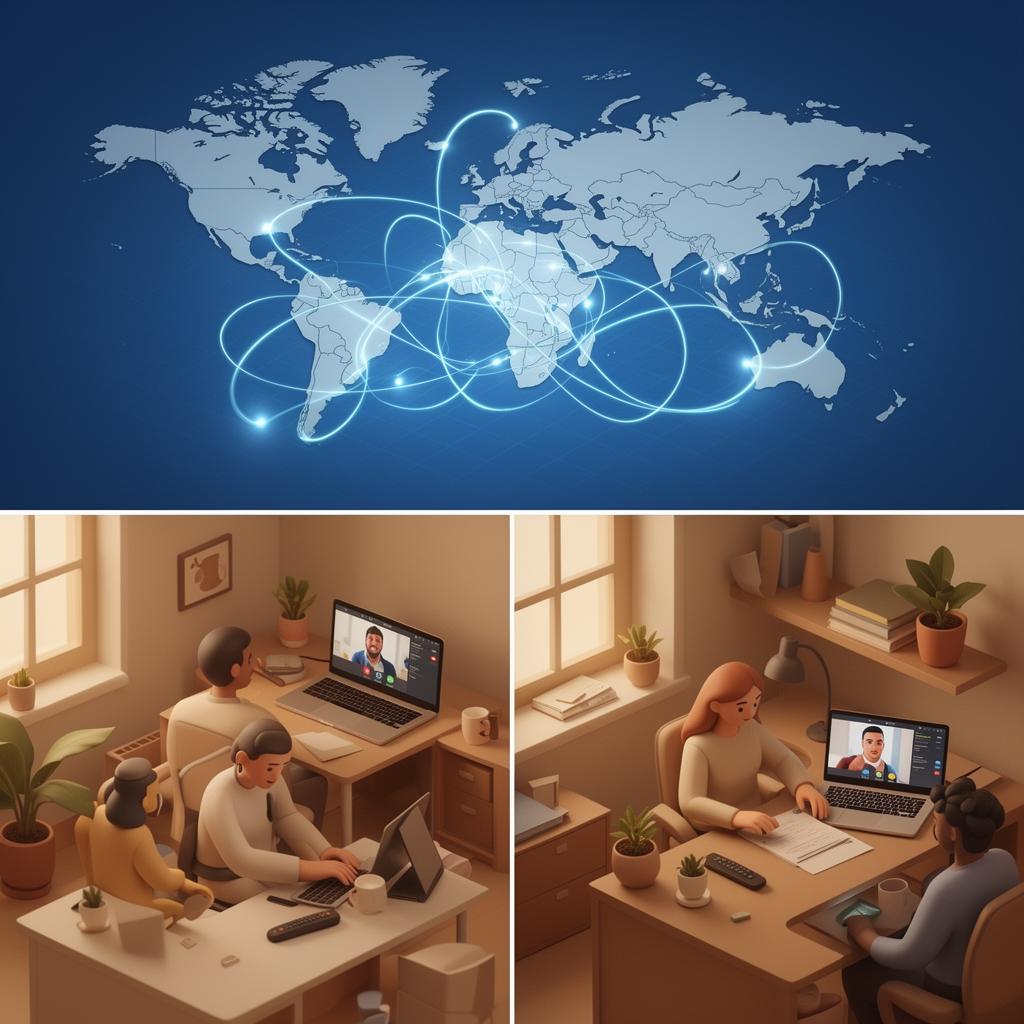
The Hidden Pitfalls of Managing Offshore Teams Through Account Managers
Why delegating 1:1s to intermediaries erodes trust, feedback, and team performance
Offshoring can unlock talent, speed, and scale, but it also introduces unique people management challenges that are often overlooked. One of the most insidious is the breakdown in the manager-developer relationship when Engineering Managers (EMs) delegate people management responsibilities (like 1:1s) to third-party account managers.
Async tools like a free Slack standup bot can help bridge time zone gaps without sacrificing the direct manager relationship.
The Indirect 1:1: A Management Mirage
In some offshore setups, the EM never actually speaks with the individual contributors. Instead, they meet with the account manager, who in turn conducts 1:1s with the developers. On paper, it looks like everyone is being "managed," but in practice, this structure erodes key dynamics that are essential for effective team leadership.
The Telephone Game Problem
When feedback flows through intermediaries, it suffers from the same distortion as the children's game "telephone." Critical context gets lost, nuance disappears, and the original message becomes unrecognizable.
How Information Gets Distorted
Original feedback from EM: "The authentication service implementation is well-structured, but I'm concerned about the error handling around edge cases. Could we add more specific exception types and improve the logging for production debugging?"
Account manager's interpretation: "The manager thinks the code is good but wants better error handling."
What the developer hears: "Make the error handling better." (No context about why, what specific cases, or how this impacts production operations)
The result: The developer implements generic try-catch blocks instead of the thoughtful exception architecture the EM actually wanted.
Context Loss in Career Development
What the EM observes: "Sarah's code reviews have become increasingly detailed and insightful. She's ready for more architectural responsibility."
What the account manager reports: "Sarah is doing good work on code reviews."
What Sarah receives: Generic positive feedback with no actionable career guidance.
The impact: Sarah doesn't know she's being considered for technical leadership and doesn't get the stretch assignments that would accelerate her growth.
Technical Nuance Gets Simplified
Engineering feedback is often highly technical and contextual. Account managers, who may lack deep technical backgrounds, naturally simplify complex feedback into generic suggestions. The specificity that makes feedback actionable gets lost in translation.
Emotional Context Disappears
Tone, emphasis, and emotional context — crucial elements of effective feedback — get filtered out when relayed through intermediaries. An EM's excitement about a developer's innovative solution becomes "positive feedback." Genuine concern about technical debt becomes "some concerns were mentioned."
How Async Standups Bridge Timezone Gaps
The timezone challenge is real, but delegating management to intermediaries isn't the solution. Async standups offer a better alternative:
Continuous Visibility Across Time Zones
With async standups, EMs get daily insights into their offshore team's work without scheduling overlapping meetings:
- What challenges engineers are facing in real-time
- Which projects are progressing smoothly vs encountering friction
- How team members are feeling about their work and workload
- What blockers need immediate attention from the EM
Direct Communication Channel
Async standups create a direct line of communication between EMs and individual contributors:
- Engineers share updates in their own words, preserving context and nuance
- EMs can respond directly to specific concerns or questions
- No information gets filtered or reinterpreted by intermediaries
- Cultural and communication styles remain authentic
AI-Powered Pattern Detection
Tools like Vereda AI analyze async standup responses to surface patterns that might be missed in weekly account manager summaries:
- Declining engagement or enthusiasm from specific team members
- Recurring blockers that suggest process or tooling issues
- Signs of burnout or frustration emerging over time
- Technical discussions that reveal growth opportunities or skill gaps
Flexibility Without Compromise
Async standups provide the timezone flexibility offshore teams need while maintaining direct management relationships:
- Engineers post updates when convenient in their timezone
- EMs review and respond when convenient in theirs
- No one loses sleep for unnecessary synchronous meetings
- Management quality doesn't suffer due to schedule constraints
Example: Before and After
Before (Account Manager Mediated):
Weekly call: "The team is doing well. A few blockers came up, but we're handling them. Raj is working on the API integration, Priya is fixing some bugs."
After (Async Standups):
- Raj: "Working on API integration. Struggling with rate limiting - their docs don't match actual behavior. Could use guidance on error handling patterns."
- Priya: "Fixed 3 bugs in payment flow. Found pattern - validation logic inconsistent across services. Worth discussing architecture implications?"
The difference is night and day in terms of actionable information and coaching opportunities.
Building Trust Remotely
Trust is the foundation of effective engineering teams, and it's even more critical for distributed offshore teams. Building trust remotely requires intentional effort:
Consistency Over Frequency
You don't need daily video calls, but you need predictable, reliable touchpoints:
- Async standups that you actually read and respond to
- Regular 1:1s scheduled at reasonable times for both parties
- Consistent response times to questions and requests for help
- Follow-through on commitments made during conversations
Technical Credibility Through Code Review
Participate directly in code reviews with offshore team members:
- Provide specific, constructive feedback on technical approaches
- Ask questions that show you understand the complexity of their work
- Recognize elegant solutions and innovative approaches publicly
- Share context about why certain technical decisions matter for the business
Career Development Investment
Show offshore developers you care about their growth:
- Discuss career goals and provide specific guidance on advancement
- Recommend them for challenging assignments and stretch opportunities
- Include them in architectural discussions and technical decision-making
- Advocate for their promotion or recognition when appropriate
Cultural Bridge-Building
Take time to understand cultural differences and communication styles:
- Learn about their local holidays and schedule around them
- Understand cultural norms around hierarchy and direct feedback
- Adapt your communication style to be effective across cultural contexts
- Show interest in their local tech community and professional development
Transparency About Business Context
Share the bigger picture:
- Explain how their work connects to business goals and customer outcomes
- Include them in product roadmap discussions and strategic planning
- Share customer feedback about features they've built
- Be transparent about company performance and how it affects their team
Trust Indicators to Track:
- Do offshore developers proactively ask questions and raise concerns?
- Do they volunteer for challenging assignments?
- Do they share innovative ideas or process improvement suggestions?
- Do they refer other talented developers to join the team?
- Do they stay with the company long-term versus churning quickly?
Trust can't be built through account manager relationships — it requires direct, consistent, authentic interaction between managers and individual contributors.
Specific Anti-Patterns in Offshore Management
Certain management approaches that might work with co-located teams become toxic with offshore arrangements:
Anti-Pattern #1: The Status Update Trap
*What it looks like*: All interactions with offshore developers focus on task status and delivery timelines.
*Why it's harmful*: Reduces skilled engineers to task executors, eliminates opportunities for coaching and growth, creates transactional rather than developmental relationships.
*Better approach*: Use 1:1 conversations to discuss technical approaches, career goals, and process improvements alongside delivery updates.
Anti-Pattern #2: The Assumption of Limited Context
*What it looks like*: Providing offshore developers with minimal background information, assuming they "just need to execute" the requirements.
*Why it's harmful*: Engineers make better decisions when they understand the broader context. Limiting context creates brittle solutions and missed opportunities for innovation.
*Better approach*: Share business context, customer feedback, and technical constraints. Include offshore developers in product discussions and architectural decisions.
Anti-Pattern #3: The Timezone Excuse
*What it looks like*: Using timezone differences to justify minimal interaction, relegating offshore team members to "implementation only" roles.
*Why it's harmful*: Creates a two-tier system where offshore developers get less mentorship, career development, and strategic involvement.
*Better approach*: Use async communication for regular touchpoints and schedule occasional overlapping hours for real-time collaboration when it adds value.
Anti-Pattern #4: The Cultural Stereotyping
*What it looks like*: Making assumptions about communication styles, work habits, or technical capabilities based on geography or cultural background.
*Why it's harmful*: Prevents managers from seeing individual strengths and growth potential, creates self-fulfilling prophecies of limited capability.
*Better approach*: Treat each developer as an individual with unique skills, communication preferences, and career aspirations. Adapt your management style to each person, not to perceived cultural norms.
Anti-Pattern #5: The Quality Control Bottleneck
*What it looks like*: Assuming offshore work needs extra quality checking or "fixing" by onshore team members.
*Why it's harmful*: Undermines confidence, prevents skill development, creates unnecessary delays and overhead.
*Better approach*: Invest in proper onboarding, clear coding standards, and collaborative code review. Trust and verify through normal engineering processes, not special "offshore" quality gates.
The Direct Relationship Imperative
The most successful offshore engineering arrangements maintain direct manager-developer relationships. Here's why this matters and how to make it work:
Why Direct Relationships Are Non-Negotiable
Career Development Requires Personal Investment
Career coaching can't be outsourced. Understanding an engineer's strengths, growth areas, and aspirations requires personal relationship and ongoing observation. Account managers may know project status, but they don't know that Sarah asks excellent architecture questions in code reviews or that Raj has been studying machine learning in his spare time.
Technical Coaching Needs Technical Context
Effective technical feedback requires understanding the codebase, system architecture, and business requirements. Account managers rarely have this depth of technical knowledge, so their feedback tends to be generic rather than actionable.
Trust Building Requires Authenticity
Developers need to trust that their manager understands their work, cares about their growth, and will advocate for them. This trust can't be built through intermediaries — it requires direct interaction over time.
Performance Issues Need Direct Addressing
When performance problems arise, they need to be addressed quickly and directly. Filtering feedback through account managers introduces delays and reduces the chance of successful improvement.
How to Maintain Direct Relationships Across Time Zones
Scheduled Overlap Hours
Identify 2-3 hours per week when EMs and offshore developers can overlap:
- Use this time for 1:1s, architectural discussions, and complex problem-solving
- Rotate the timing so the timezone burden is shared
- Make these sessions highly valuable to justify the scheduling complexity
Async Communication Excellence
Invest in high-quality async communication:
- Detailed async standups that provide real insight into daily work
- Thoughtful code reviews with context and explanation
- Regular async check-ins on goal progress and career development
- Shared documentation that maintains context across time zones
Include Offshore Developers in Strategic Discussions
- Architecture and design discussions via recorded videos or collaborative documents
- Product roadmap planning through async input and feedback
- Technical decision-making through RFCs and collaborative review processes
- Team retrospectives and process improvement initiatives
Regular Video Check-ins
Even with great async communication, face-to-face interaction matters:
- Monthly 1:1 video calls for relationship building and career discussions
- Quarterly team video meetings for culture and strategic alignment
- Ad-hoc video calls when complex issues require real-time discussion
Success Metrics for Direct Relationships:
- Offshore developers contribute to architectural and product decisions
- Retention rates are comparable to onshore team members
- Career advancement happens at similar rates
- Offshore developers take initiative and drive improvements
- Cross-team collaboration happens naturally
- Innovation and creative solutions come from the offshore team
How Vereda AI Helps with Distributed Teams
Managing offshore teams effectively requires better tools, not just good intentions. Vereda AI addresses many of the unique challenges:
Continuous Visibility Across Time Zones
Vereda AI analyzes async standups and communication patterns to provide EMs with comprehensive team insights:
- Daily team health summaries: Understand who's blocked, who's making progress, and who might need attention
- Engagement pattern analysis: Detect when offshore team members are becoming disengaged before it affects performance
- Blocker identification: Surface issues that need EM intervention, even when mentioned briefly in async updates
- Collaboration tracking: See who's working well together and who might benefit from more support
Cultural and Communication Pattern Recognition
AI can detect communication patterns that humans might miss:
- Language nuances: Identify when "everything is fine" might actually indicate frustration or confusion
- Cultural communication styles: Understand when indirect communication is signaling problems
- Confidence levels: Track when developers are expressing uncertainty and might benefit from coaching
- Initiative indicators: Notice when team members are going above and beyond or contributing creative solutions
Performance Insights Without Micromanagement
Vereda AI provides performance visibility without requiring constant check-ins:
- Code contribution analysis: Understand the complexity and impact of work being delivered
- Quality indicators: Track code review participation, bug rates, and production stability contributions
- Growth pattern recognition: Identify when developers are taking on new challenges or demonstrating increased capabilities
- Team dynamic insights: See how offshore and onshore team members collaborate and where relationships are strongest
Proactive Issue Detection
Early warning systems for common offshore team challenges:
- Communication breakdown alerts: When responses become shorter or less engaged
- Isolation warning signs: When team members stop participating in collaborative activities
- Overwork indicators: When async updates suggest unsustainable pace or stress
- Skill development opportunities: When team members express interest in new technologies or responsibilities
1:1 Prep for Distributed Teams
Vereda AI generates talking points for 1:1s that account for timezone and cultural factors:
- Recent work context that shows you're paying attention despite the distance
- Specific recognition opportunities based on code contributions and team collaboration
- Growth conversation starters based on observed skill development
- Process improvement suggestions based on blockers and friction points identified in async updates
Account Manager Alternative
Instead of relying on account managers for team insights, Vereda AI provides:
- Objective data analysis rather than filtered interpretations
- Individual-level insights rather than team-level summaries
- Technical context that account managers typically lack
- Pattern recognition over longer time periods than human observation allows
Cultural Bridge-Building Support
AI helps EMs understand and adapt to different communication styles:
- Communication pattern analysis: How different team members prefer to share updates and feedback
- Engagement style recognition: Who participates actively in discussions vs. who contributes more thoughtfully in writing
- Stress and satisfaction indicators: How different cultural backgrounds express work satisfaction or frustration
- Career aspiration signals: What different team members value in terms of growth and recognition
Learn more about how Vereda AI supports distributed team management and enables direct relationships across time zones.
Final Thought
Great engineering management is not just about shipping code. It is about building relationships, coaching people, and removing blockers. Delegating that responsibility to a third party may seem efficient, but it often comes at the cost of trust, clarity, and long-term team health.
The hidden costs of indirect management:
- Talented offshore developers leave because they feel undervalued and underdeveloped
- Technical quality suffers because feedback lacks specificity and context
- Innovation decreases because developers are treated as implementers rather than contributors
- Cultural integration fails because authentic relationships never develop
- Career advancement stagnates because growth conversations happen through intermediaries
The alternative is challenging but achievable:
- Use async communication tools to maintain direct relationships across time zones
- Invest in 1:1s and career development conversations despite scheduling complexity
- Participate directly in code reviews and technical discussions
- Build trust through consistency and authentic interest in individual growth
- Leverage AI tools to maintain visibility without micromanagement
Offshoring should be a force multiplier, not a blind spot. When done right, distributed teams bring diverse perspectives, extended working hours, and access to global talent pools. When done wrong, they become expensive, low-trust arrangements that produce mediocre results.
The choice is yours: build real teams or manage contractors. The investment in direct relationships pays dividends in quality, retention, innovation, and business outcomes.
For more insights on building strong engineering teams, read our guides on effective 1:1 meetings and maintaining team health.